David Jon DeJonge
Son of Victor Kenneth de Jonge.
Family history · Work, faith, and continuity
From Smilde to the United States, the De Jonge family story follows generations of work, enterprise, migration, faith, public responsibility, and persistence.
The direct line
The 1993 family book, American family records, civil indexes, and surviving pedigrees trace the paternal line from eighteenth-century Drenthe to the American branch.
Son of Victor Kenneth de Jonge.
Son of Henry de Jonge and Jemima de Waal Malefyt.
Born in Smilde; immigrated to New Jersey; builder and business owner.
Farmer and peat operator in Smilde; married Arentiena Henderika Offereins.
Farmer and peat operator; married Elsje de Vries.
Glass-factory owner; married Catharina Henderika Swalue in 1824.
Son of Reinder Reinders and Jentje Keessen de Jonge. The records indicate that he adopted his mother’s surname.
The surname entered this branch through Jentje Keessen de Jonge and continued through the family’s Smilde descendants.
Enterprise across generations
The family record is strongest when it follows work actually done. The surviving histories describe people who repeatedly converted practical skill into durable institutions and businesses.
The 1993 family history records that direct ancestor Hendrik de Jonge, 1796–1840, held a half-interest in the Thöne & Compagnie glassworks at Nieuw-Buinen.
Cornelis de Jonge rose from orphaned farmhand to farmer, peat operator, and substantial landholder; the 1888 estate auction lists 52 lots of land, houses, and peat ground. His son Hendrik continued in agriculture, church and civic service, and reportedly helped establish the local farmers’ credit bank.
Henry’s elder brother Cornelius Hendrik “Kees” de Jonge trained as a carpenter and developed a contracting firm that pursued municipal work, housing, roofing materials, and insurance. He belongs to a close collateral branch—not David’s direct line.
Family records describe Henry de Jonge as a mason, house builder, and owner of a home-heating business. His American life joined manual skill, architectural study, enterprise, and long-term provision for a growing family.
David followed a recognizably similar pattern: building DeJonge Studio from a basement practice, organizing a national remembrance campaign, and developing Legacy Icons around craft, historical accuracy, and cultural preservation.
The Netherlands at war
The 1993 family history describes three close relatives whose lives crossed mobilization, underground activity, and national reconstruction.
Hendrik de Jonge, born in 1915, is described as a Dutch non-commissioned officer who experienced the war days in Rotterdam after mobilization in 1939.
Cornelis Jacobus “Koos” de Jonge, born in 1921, worked in his father’s office during the occupation. The book states that he “zat in de illegaliteit”—literally, “was in the underground”—without providing further operational detail.
Albert de Jonge, born in 1917, is described as a wartime technical inspector and as working in 1945–46 with Wederopbouw Boerderijen, the postwar farm-reconstruction effort. He later helped continue the family contracting and public-works business.
All three men were first cousins of Victor Kenneth de Jonge and first cousins once removed from David.
Nationaal Archief: postwar agricultural restoration records ↗The American branch
Henry de Jonge left Smilde for the United States in the early 1920s and married Jemima de Waal Malefyt in New Jersey in 1925.
The family memoir describes a succession of jobs, masonry work, architectural coursework, house building, and the growth of a home-heating business. Henry and Jemima raised seven children, connecting the Smilde record directly to Victor Kenneth de Jonge and the Michigan branch.
This is the family history nearest to David’s own career: begin with a craft, earn trust, build a practical enterprise, and use the result to support work larger than oneself.
The Swalue–Van Belkum branch
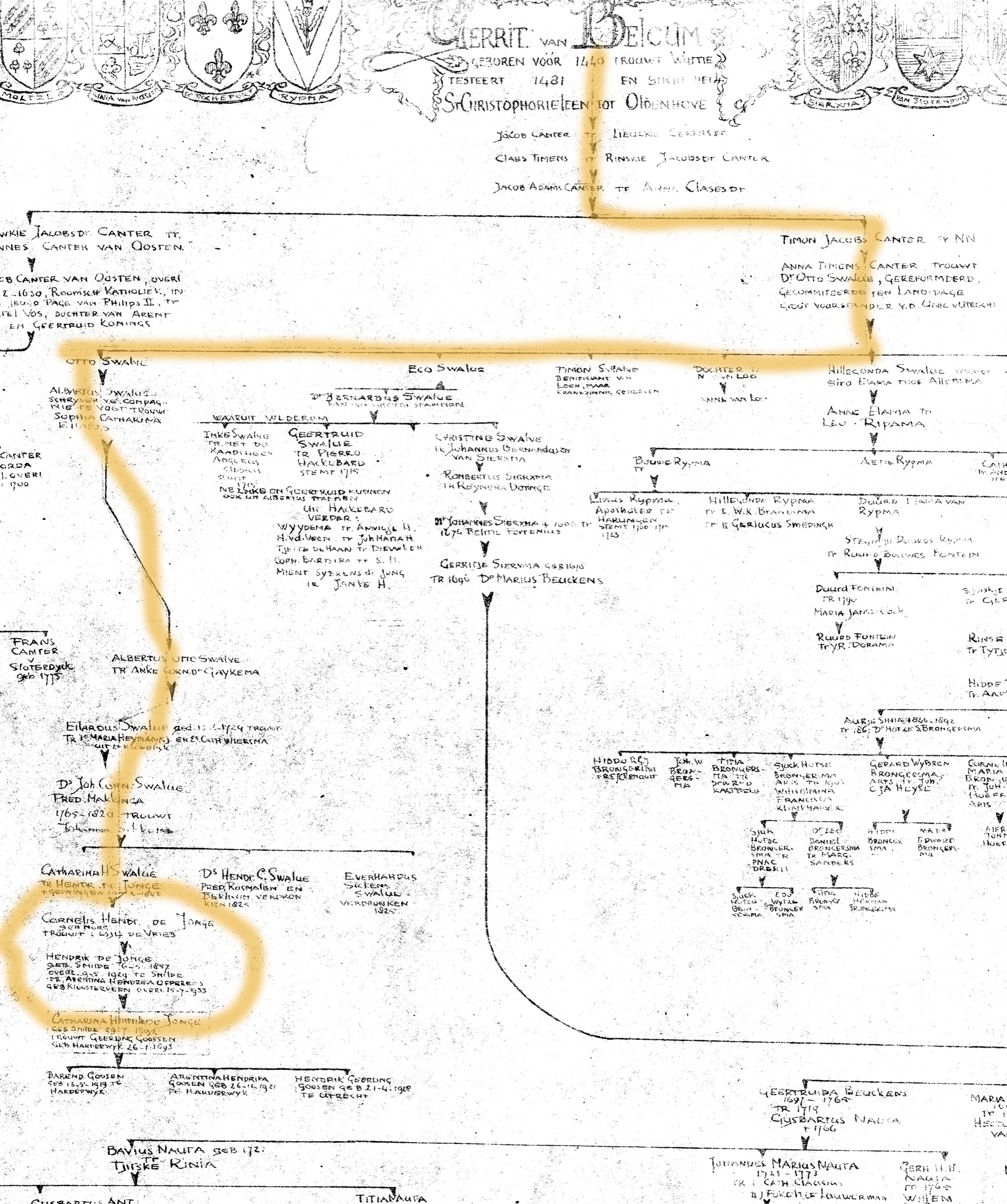
Hendrik de Jonge’s 1824 marriage to Catharina Henderika Swalue brings the Swalue family into David’s paternal ancestry.
The pedigree traces that branch to Gerrijt van Belcum, the Leeuwarden merchant who founded the Sint Christophorileen tot Oldehove in 1480. The pedigree preserves Van Belcum for the founder while the family chart is commonly described as the Van Belkum line. The foundation originally supported a priest and now provides educational assistance to qualifying descendants.
Family records identify Victor Kenneth de Jonge as having served on the foundation’s board following its review of his descent.
Read the foundation’s official history ↗A mark with a real history
David’s original studio logo combines a black photographic aperture, a faceted red star, and a restrained field of gray stars. Rooted in his years as a working photographer, it remains a contemporary personal mark rather than a coat of arms or institutional seal.
The historic Swalue arms preserve part of that ancestral branch’s visual history.
The aperture-and-star design, used throughout David’s photography career, remains his professional mark.
Black aperture: photography and disciplined observation. Faceted red star: the original focal point. Gray stars: continuity with the mark used throughout David’s photography career.
An adopted personal motto
Defensio Indefensorum
“Defending the Defenseless.”
The motto describes David’s own work: preserving the testimony of overlooked veterans, advocating for public remembrance, and protecting sacred and cultural inheritance. It is an adopted personal motto, chosen for the work it describes.
What carries forward
Across generations, different kinds of work echo through craft, enterprise, rebuilding, service, and preservation.
Farmers, peat operators, carpenters, contractors, builders, and entrepreneurs turned practical ability into durable work.
Military service, wartime experience, migration, and reconstruction placed family lives inside larger historical events.
David’s portraiture, World War I advocacy, education, and sacred-art work continue the pattern through documentation and public action.
The through-line is earned responsibility: the repeated decision to make, preserve, rebuild, protect, and keep one’s word.
Family archive
The family collection includes the 1993 history, the historic Van Belkum pedigree, photographs, civil records, correspondence, and related family materials.
Preservation work includes image restoration, Dutch transcription, English translation, and organized source documentation.
Research resources
General institutional resources used to interpret family, resistance, and heraldic records.
The enduring purpose
Defensio Indefensorum.
Defending the Defenseless.