British continuation · Britain 03

William Frederick ‘Bill’ Stone

🇬🇧United Kingdom

Royal Navy · First and Second World Wars

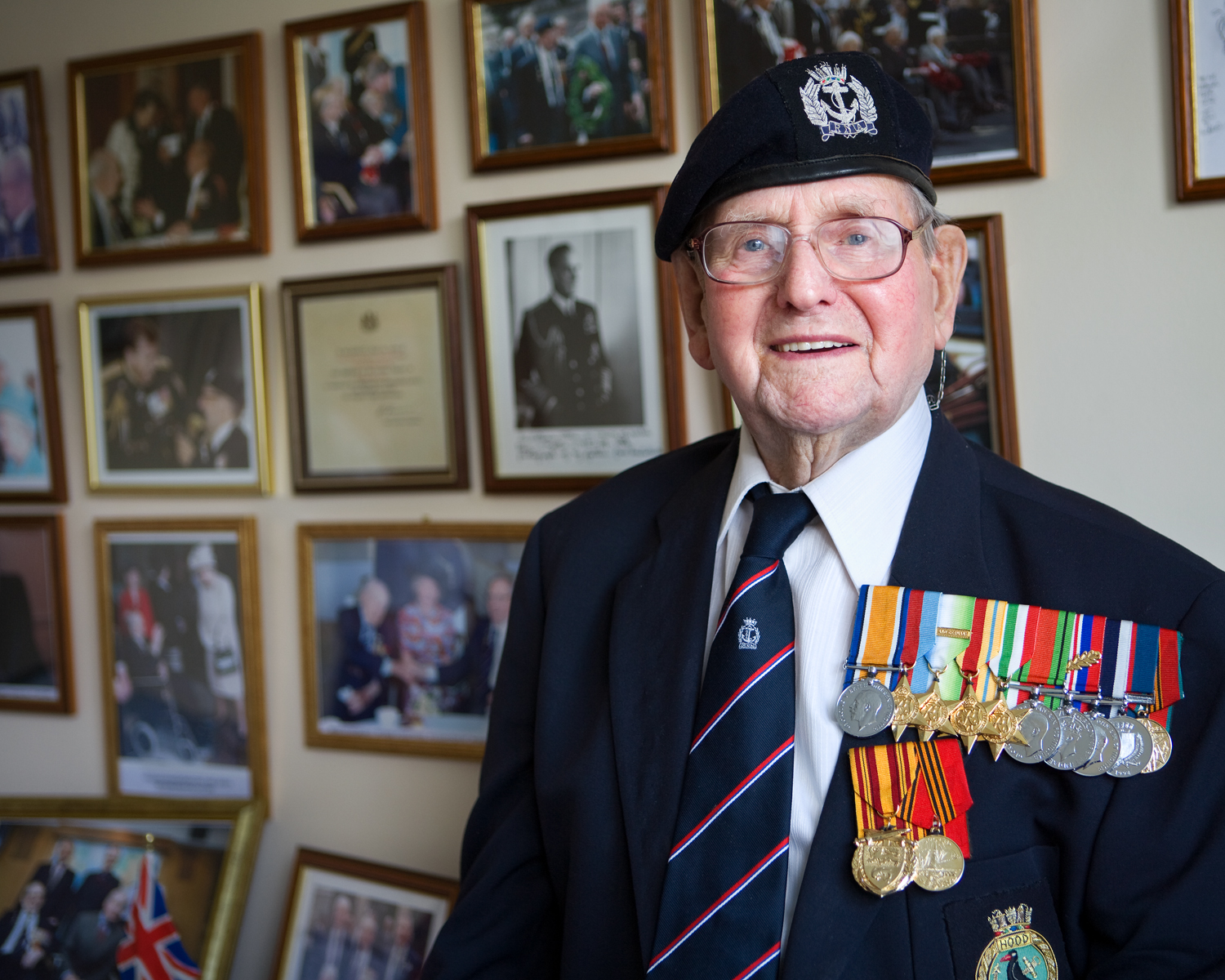
William Stone was the last known veteran living in the United Kingdom to have served in both the First and Second World Wars.

Portrait of Royal Navy veteran William Stone by David J. DeJonge
Photograph by David J. DeJonge · From the Last Witnesses portrait record
Collection
British continuation
Service nation
United Kingdom
Service
Royal Navy · First and Second World Wars

The verified story

A life carried forward in the record.

William Frederick “Bill” Stone was born September 23, 1900, in Ledstone, South Devon, the tenth of fourteen children. Three older brothers were already serving when, at fifteen, he tried to join the Royal Navy. His father refused the required permission. Stone returned on his eighteenth birthday in 1918 and enlisted at Devonport, initially training as a stoker before influenza interrupted his preparation.

The Armistice came before he reached a wartime ship, but Stone remained in the Navy. He served in HMS Tiger and later HMS Hood, joining the 1923–24 “Empire Cruise.” His career then carried the First World War generation into a second global conflict. As chief stoker in HMS Salamander, he made five Dunkirk evacuation trips and later served on Arctic convoy duty. In HMS Newfoundland, he took part in the Sicily landings and was mentioned in dispatches after the cruiser was torpedoed.

Stone completed twenty-seven years of naval service in 1945. He became a barber and tobacconist in civilian life and remained active in veterans’ organizations. His family remembered a determined man of faith whose motto was “Keep Going.”

DeJonge’s portrait places Stone beside Allingham and Patch as part of the British continuation of the project. His significance is different from theirs: not the final trench fighter or RAF founder, but a sailor whose service formed a living bridge between both world wars.
The completed record

What followed.

Stone died on January 10, 2009, at 108. The British Ministry of Defence identified him as the last known veteran living in the United Kingdom to have served in both the First and Second World Wars. After DeJonge’s session, he joined Henry Allingham and Harry Patch at the Cenotaph on November 11, 2008, for the 90th anniversary of the Armistice. His record should not be expanded into “last Royal Navy veteran” or “last British First World War veteran,” neither of which is the precise distinction documented by the Ministry.

The archive · c. 2009–2010

David’s original exhibition story.

This text is preserved from the original traveling-exhibition record. It retains the language, grammar, and understanding of that moment. Dates, survivor distinctions, and later developments are corrected in the verified record above.

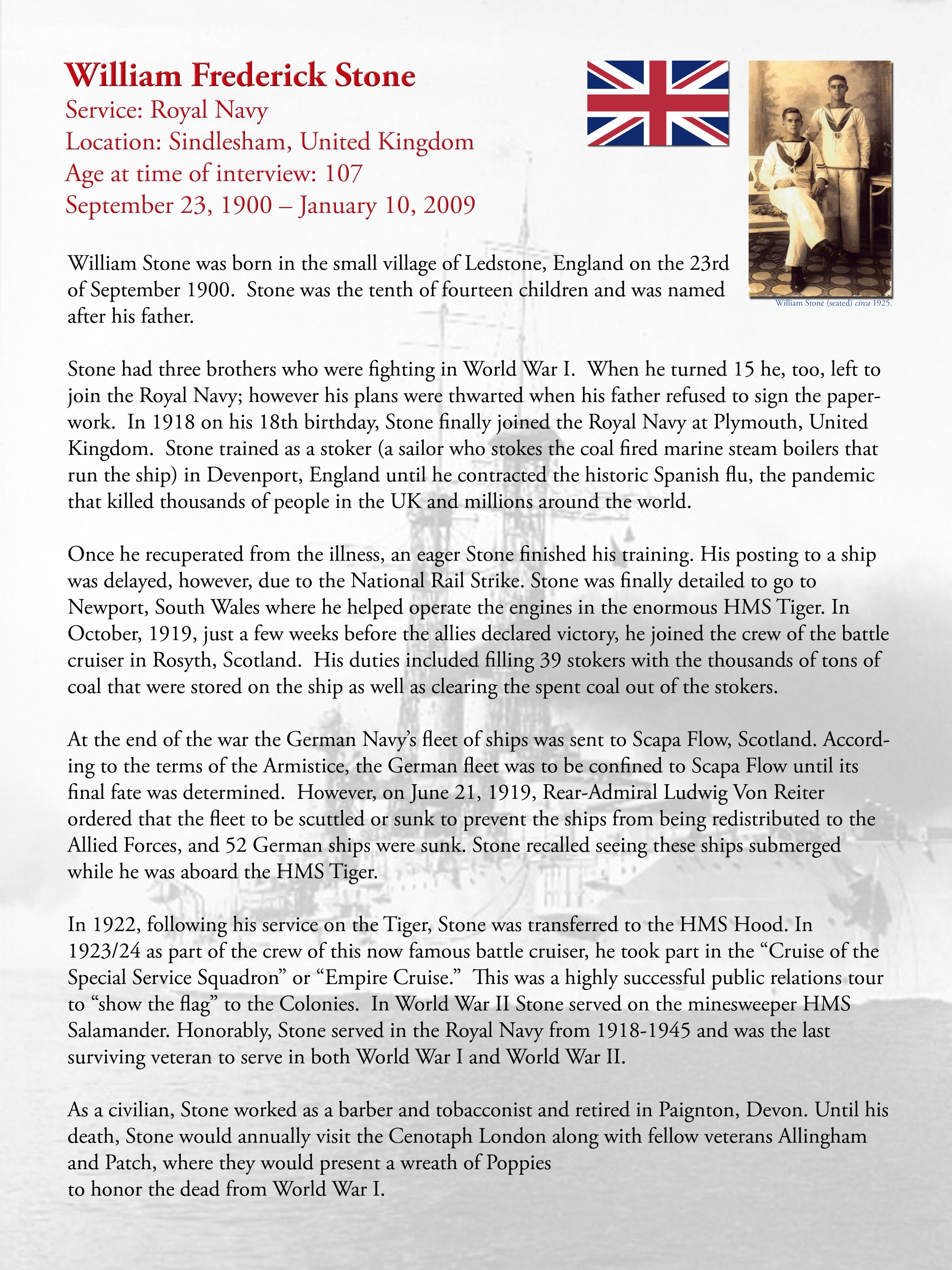
Original exhibition story panel for William Frederick Stone
Original exhibition panel by David J. DeJonge · Select to view at full web resolution
Read the complete original text

Service: Royal Navy Location: Sindlesham, United Kingdom Age at time of interview: 107 September 23, 1900 – January 10, 2009

William Stone was born in the small village of Ledstone, England on the 23rd of September 1900. Stone was the tenth of fourteen children and was named after his father.

Stone had three brothers who were fighting in World War I. When he turned 15 he, too, left to join the Royal Navy; however his plans were thwarted when his father refused to sign the paperwork. In 1918 on his 18th birthday, Stone finally joined the Royal Navy at Plymouth, United Kingdom. Stone trained as a stoker (a sailor who stokes the coal fired marine steam boilers that run the ship) in Devenport, England until he contracted the historic Spanish flu, the pandemic that killed thousands of people in the UK and millions around the world.

Once he recuperated from the illness, an eager Stone finished his training. His posting to a ship was delayed, however, due to the National Rail Strike. Stone was finally detailed to go to Newport, South Wales where he helped operate the engines in the enormous HMS Tiger. In October, 1919, just a few weeks before the allies declared victory, he joined the crew of the battle cruiser in Rosyth, Scotland. His duties included filling 39 stokers with the thousands of tons of coal that were stored on the ship as well as clearing the spent coal out of the stokers.

At the end of the war the German Navy’s fleet of ships was sent to Scapa Flow, Scotland. According to the terms of the Armistice, the German fleet was to be confined to Scapa Flow until its final fate was determined. However, on June 21, 1919, Rear-Admiral Ludwig Von Reiter ordered that the fleet to be scuttled or sunk to prevent the ships from being redistributed to the Allied Forces, and 52 German ships were sunk. Stone recalled seeing these ships submerged while he was aboard the HMS Tiger.

In 1922, following his service on the Tiger, Stone was transferred to the HMS Hood. In 1923/24 as part of the crew of this now famous battle cruiser, he took part in the “Cruise of the Special Service Squadron” or “Empire Cruise.” This was a highly successful public relations tour to “show the flag” to the Colonies. In World War II Stone served on the minesweeper HMS Salamander. Honorably, Stone served in the Royal Navy from 1918-1945 and was the last surviving veteran to serve in both World War I and World War II.

As a civilian, Stone worked as a barber and tobacconist and retired in Paignton, Devon. Until his death, Stone would annually visit the Cenotaph London along with fellow veterans Allingham and Patch, where they would present a wreath of Poppies to honor the dead from World War I.

Documented record

Sources.