British continuation · Britain 02

Henry John ‘Harry’ Patch

🇬🇧United Kingdom

British Army · Duke of Cornwall’s Light Infantry

Harry Patch was the last surviving British Army veteran of the First World War and the last surviving soldier known to have fought in its trenches.

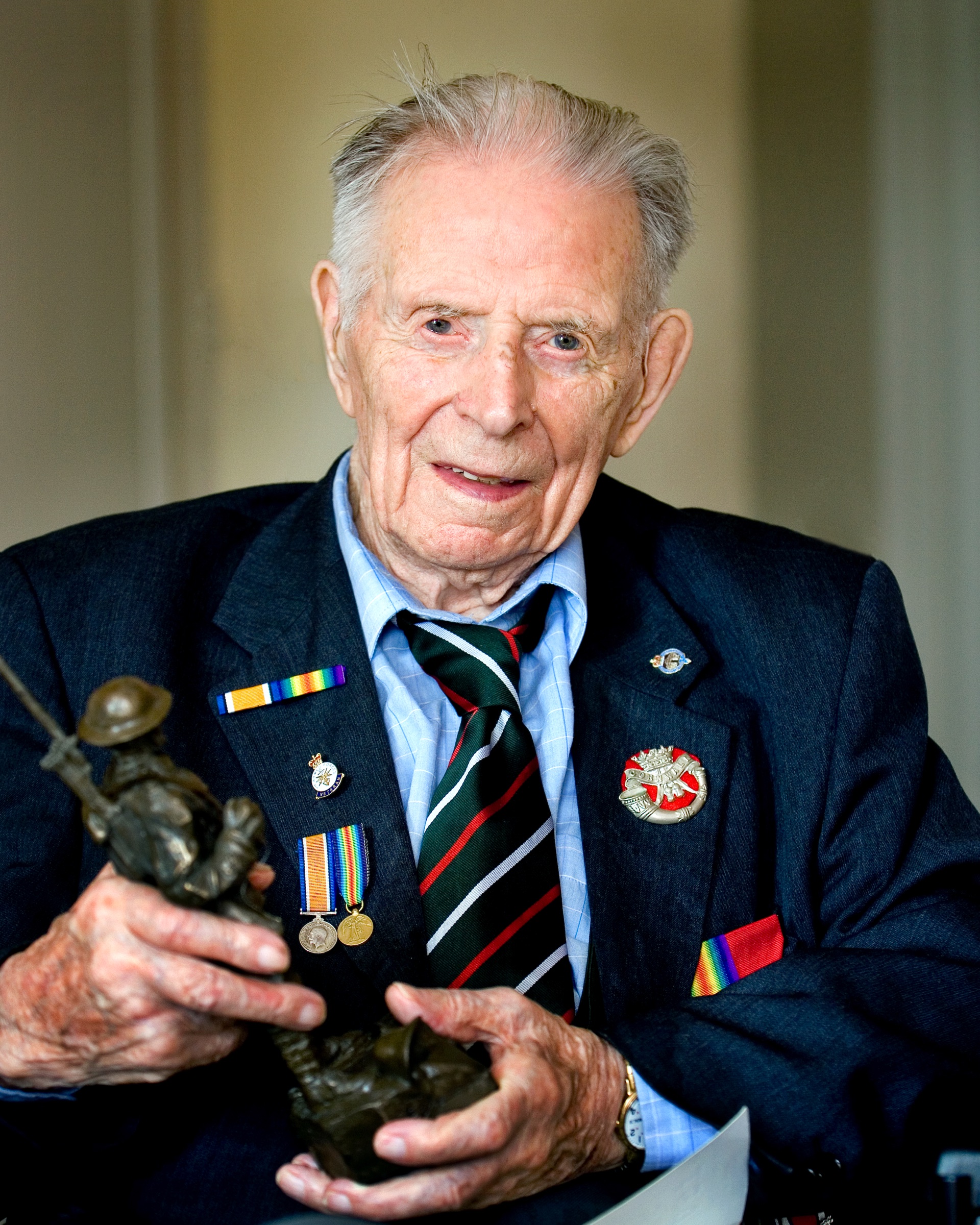
Portrait of Harry Patch holding a bronze First World War serviceman by David J. DeJonge
Photograph by David J. DeJonge · From the Last Witnesses portrait record
Collection
British continuation
Service nation
United Kingdom
Service
British Army · Duke of Cornwall’s Light Infantry

The verified story

A life carried forward in the record.

Henry John “Harry” Patch was born June 17, 1898, in Combe Down near Bath. A plumbing apprentice before the war, he was conscripted in 1916 and served with the Duke of Cornwall’s Light Infantry as the number two on a Lewis gun team. In 1917 he fought at Passchendaele, where industrial firepower and deep mud turned the battlefield into an ordeal that remained with him for the rest of his life.

Patch described ammunition boxes stacked into makeshift walkways across the mud. During the battle, shrapnel tore into his abdomen. With anesthetic unavailable, a doctor removed a jagged fragment while four men held him down. He survived; members of his gun team did not. For decades he rarely spoke about the war. In old age, he returned to Passchendaele, honored comrades on both sides, and became a forceful witness for peace.

During DeJonge’s encounter, a question about the war brought a long stillness. Patch looked through the window before saying, “I am the last one.” The loneliness inside that fact became central to the portrait. In another defining image, Patch holds a small bronze First World War serviceman. The object fits in his hands, but it stands for a generation too large for any one survivor to carry.

Patch urged younger people to support lifeboats because they save lives rather than take them. His final public role was not to glorify battle, but to tell the truth about its cost.
The completed record

What followed.

Patch died on July 25, 2009, at 111. He was the last surviving British Army veteran of the First World War and the last surviving soldier known to have fought in its trenches. After DeJonge’s session, Patch joined Henry Allingham and William Stone at the November 2008 Cenotaph commemoration and received France’s Légion d’Honneur in 2009. His nationally attended funeral at Wells Cathedral and later remembrance ceremonies honored the entire wartime generation rather than presenting him as the last British veteran of every form of service.

The archive · c. 2009–2010

David’s original exhibition story.

This text is preserved from the original traveling-exhibition record. It retains the language, grammar, and understanding of that moment. Dates, survivor distinctions, and later developments are corrected in the verified record above.

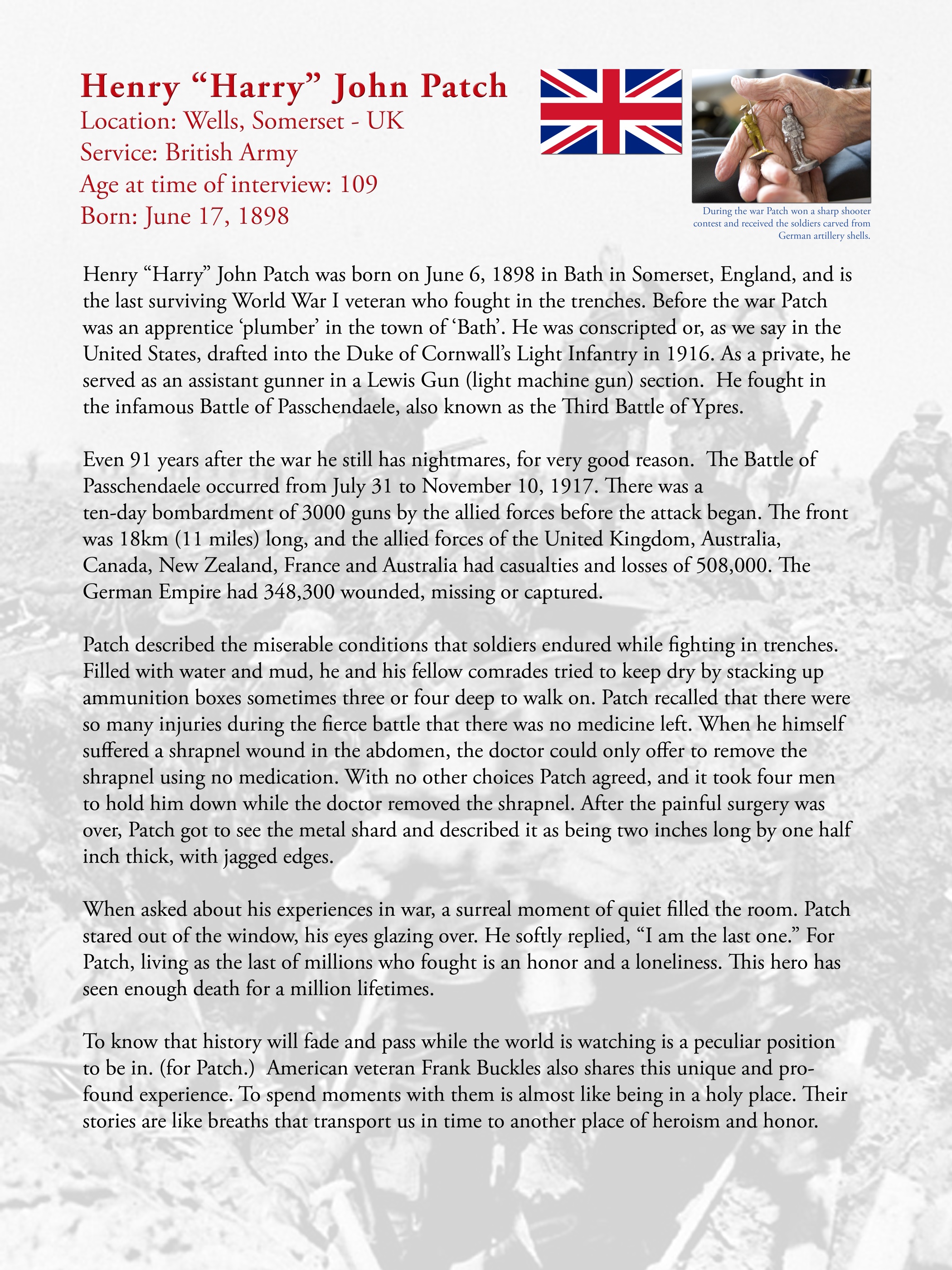
Original exhibition story panel for Henry John Patch
Original exhibition panel by David J. DeJonge · Select to view at full web resolution
Read the complete original text

Henry John Patch 'Harry’ was born on June 6, 1898 in Combe Down on the outskirts of the Somerset city of Bath and is the last surviving veteran who fought in the trenches. Ironically, Patch was a plumbing apprentice before the war in the town of Bath. Patch was conscripted or as we say in the States- drafted into the Duke of Cornwall’s Light Infantry in 1916. He reached the rank of Private and served on an assistant gunner in a Lewis Gun section. And he fought in the infamous battle of Passchendaele or the Third Battle of Ypres.

For Patch the pain from this brutal battle and the things he witnessed are still much to bare 91 years after the war he still has nightmares. For very good reason; the Battle of Passchendaele occurred from July 31 – November 10 1917. There was a ten-day bombardment of 3000 guns by the allied forces before the attack would begin. The front was 18km (11 miles) and the allied forces of the United Kingdom, Australia, Canada, New Zealand, France and Australia had casualties and losses of 508,000. The German Empire had 348,300 wounded, missing or captured.

Describing the trenches as filled with mud, they would place ammunition box on top of ammunition box sometimes three or four deep to walk through. During the battle Harry suffered shrapnel wound to the abdomen. The battle was so fierce Patch recalls that there was simply no medicine available and the doctor offered to remove the shrapnel without any medicine, Patch accepted. Four people held him down and the Doctor got to work. When the doctor finished the surgery Patch got to see the metal, which he described as 2 inches long, and a half inch thick with jagged edges.

In 2006 Patch returned to Passchendaele to view the very field he fought in and to bring honor to his comrades. When asked what to tell the next generation about what was important to him Harry simply said to fund the lifeboats because they save lives rather than take them. The Royal National Lifeboat Institution is based in England and provides lifeboats and lifeguards throughout the country.

When asked of his experience in War Harry stared out of the window and his eyes glazed over and a surreal moment of quiet filled the room. ‘I am the last one.’ For Patch living as the last of millions is an honor and a loneliness. For this hero he has seen enough death for a million lifetimes.

To know that history will fade and pass while the world is watching for it is a peculiar position to be in. This unique and profound experience is shared by Frank Buckles. To spend moments with them is almost as being in a holy place. For their stories are breathes that transport us in time to another place.

Documented record

Sources.