The Pentagon Nine · Pentagon 06

Antonio ‘Anthony’ Pierro

🇺🇸United States

U.S. Army · 82nd Division · 320th Field Artillery

Antonio Pierro was one of the final known U.S. combat veterans of the First World War and immediately preceded Howard Ramsey as the last known survivor of that group.

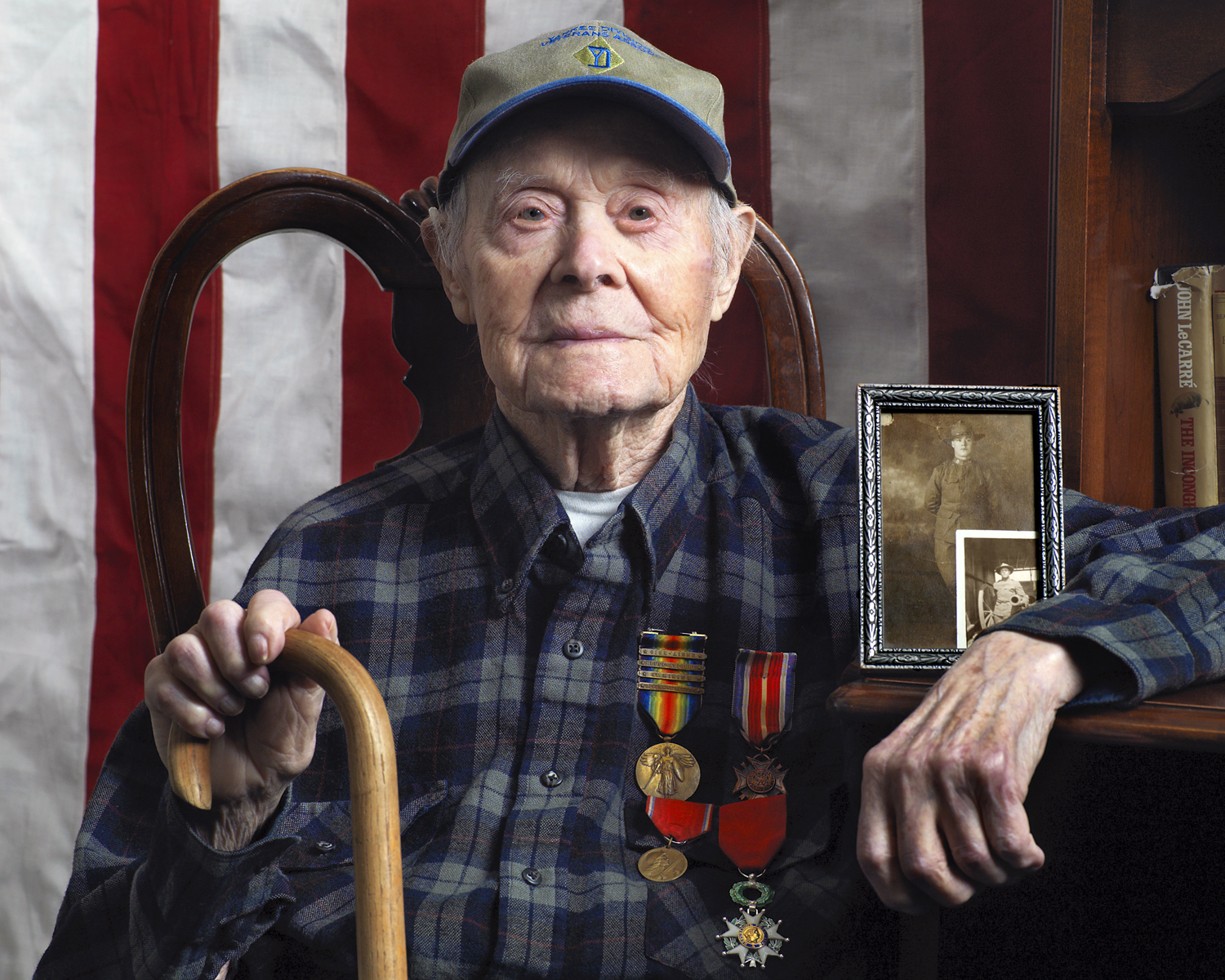
Portrait of Antonio Pierro by David J. DeJonge
Photograph by David J. DeJonge · From the Last Witnesses portrait record
Collection
The Pentagon Nine
Service nation
United States
Service
U.S. Army · 82nd Division · 320th Field Artillery

The verified story

A life carried forward in the record.

Antonio “Anthony” Pierro was born in Forenza, Italy, in February 1896 and immigrated to the United States as a young man. Small in stature—about five feet tall and 120 pounds in DeJonge’s account—he trained at Fort Dix and served in France with the 82nd Division’s 320th Field Artillery.

Pierro’s war was physical and immediate. He moved ammunition forward by horse-drawn wagon during the Saint-Mihiel and Meuse-Argonne offensives, working under shellfire near the front. He later described learning French commands because the Army’s horses had come from France: to make them move, he called “Allez!” France eventually recognized his service with the Légion d’Honneur.

When DeJonge reached him in Massachusetts, Pierro could no longer stand, but the rituals of courtesy remained. He greeted visitors with a warm smile and, when nurses approached, kissed their hands. The gestures gave the encounter an intimacy that military statistics cannot. Behind them stood the scale of the final American offensives; before the camera sat one elderly man who had tended frightened animals and carried artillery ammunition through that violence.

Pierro spent most of his final years at home with family. His portrait holds the contrast: a gracious, diminutive figure whose memory led directly to two of the largest battles fought by American forces in the war. It is a record of combat without spectacle, told through work, language, horses, and the habits of an old-world gentleman.
The completed record

What followed.

Pierro died on February 8, 2007, at 110. His death made Howard Ramsey the last known U.S. combat veteran of the First World War, placing Pierro immediately before him in that succession. DeJonge’s portrait was unveiled posthumously at the Pentagon in 2008. Published sources disagree on Pierro’s precise February birthday, most often giving either February 15 or February 22. Publishing only “February 1896” preserves what can be stated without dispute.

The archive · c. 2009–2010

David’s original exhibition story.

This text is preserved from the original traveling-exhibition record. It retains the language, grammar, and understanding of that moment. Dates, survivor distinctions, and later developments are corrected in the verified record above.

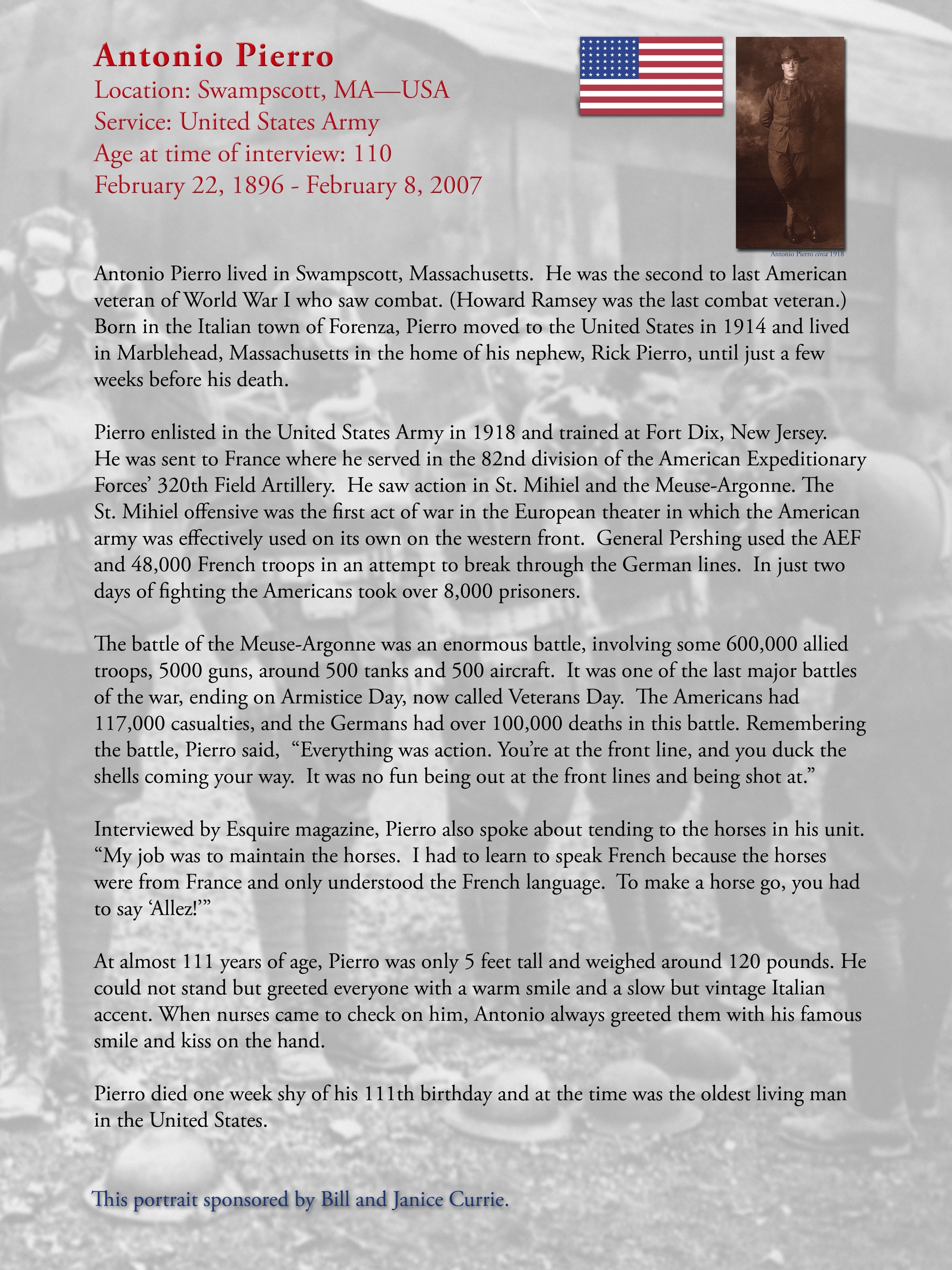
Original exhibition story panel for Antonio Pierro
Original exhibition panel by David J. DeJonge · Select to view at full web resolution
Read the complete original text

Antonio Pierro lived in Swampscott, Mass and was nearly 111-years old. Pierro was the second to last American veteran of WWI who saw combat (Howard Ramsey was the last combat veteran). Born in the Italian town of Forenza he moved to the United States of America in 1914 and lived in Marblehead, Massachusetts. In 1918 he enlisted in the United States Army he trained at Fort Dix, New Jersey.

Pierro was only 5 feet tall and around 120 pounds and could not stand but greeted everyone with a warm smile and a slow but vintage Italian accent. When the nurses would to check on him Antonio greeted them with his famous kiss on the hand and smile. Until just a few weeks before his death Pierro lived at home with his Nephew Rick.

Tony was sent to France where he saw action in St. Mihiel and the Meuse-Argonne Offensive. The St. Mihiel offensive was the first act of war in the European theater where the American Army was effectively on it’s own in the Western Front. The Germans however, began to retreat before the American advanced assisted by the French. In just 2 days of fighting the Americans took over 8000 prisoners.The battle of the Meusse-Argonne was an enormous battle involving some 600,000 Allied troops, 5000 guns, around 500 tanks and 500 aircraft. It was one of the last major battles of the war ending on Armistice. The Americans had 117,000 casualties and the Germans had over 100,000 deaths in this battle.

He served in the 82nd division of American Expeditionary Forces 320th field Artillery. “During the war everything was action, You’re at the front line, you duck the shells coming your way. It was no fun being out at the front lines, being shot at.” The Saint-Mihiel battle marked the first use of the term ‘D-Day’. Genreral Pershing used the AEF and 48,000 French troops in an attempt to break through the German lines. For these battles Pierro was awarded the French Legion of Honor and several other medals.

Interviewed for Esquire magazine, Pierro told about tending to the horses: “My job was to maintain the horses. So I had to learn to speak French because the horses we got from France understood only French. To make a horses go in France, you say, Allez!”

Pierro died one week shy of his 111th birthday and at the time was the oldest living man in the United States.

Documented record

Sources.