The Pentagon Nine · Pentagon 07

Howard Verne Ramsey

🇺🇸United States

U.S. Army · corporal and driver

Howard Ramsey was the last known U.S. combat veteran of the First World War.

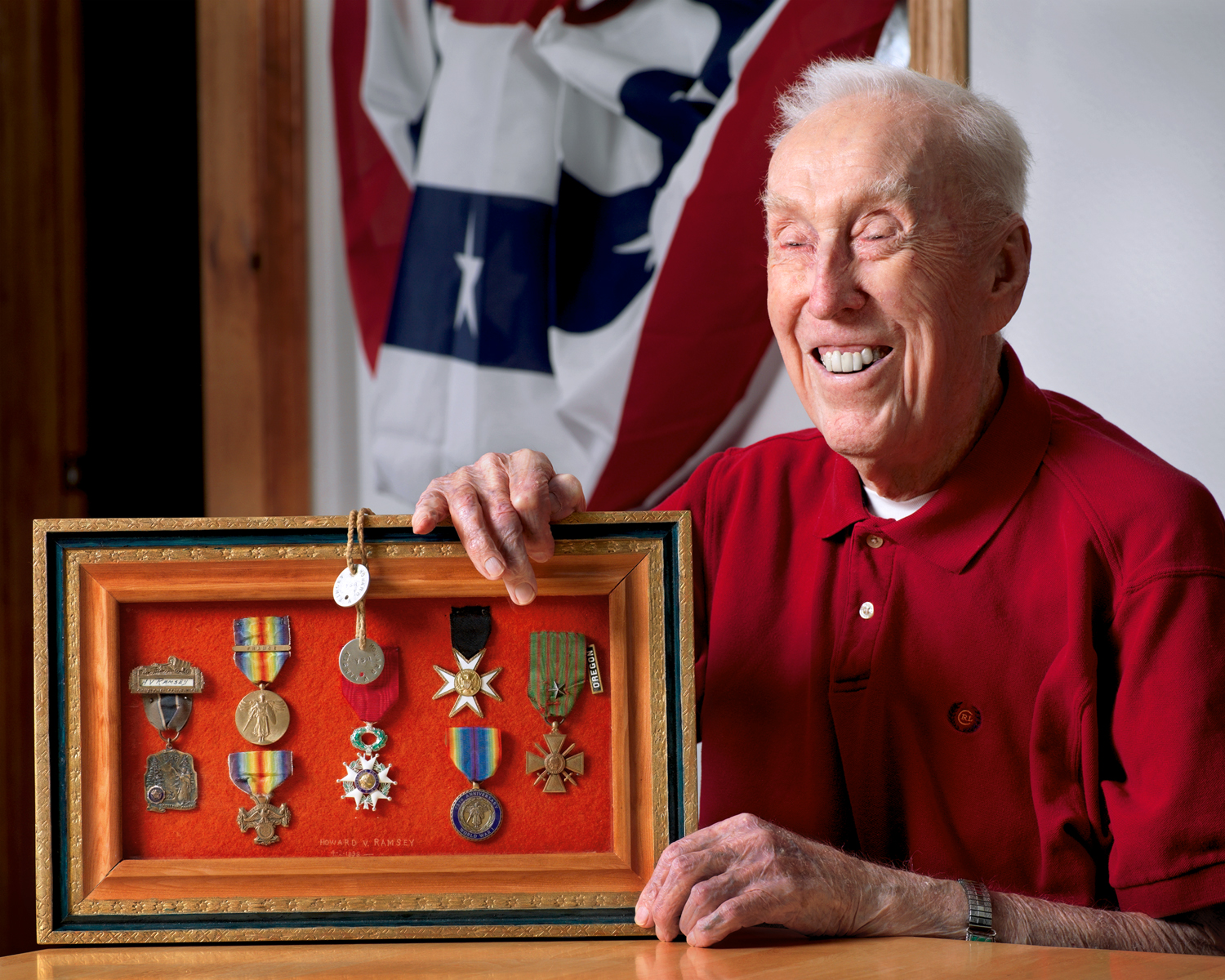
Portrait of Howard Verne Ramsey by David J. DeJonge
Photograph by David J. DeJonge · From the Last Witnesses portrait record
Collection
The Pentagon Nine
Service nation
United States
Service
U.S. Army · corporal and driver

The verified story

A life carried forward in the record.

Howard Verne Ramsey was born April 2, 1898, in Rico, Colorado, and later made his home in Portland, Oregon. Too light to enlist, he remembered eating bananas and drinking water with a friend until the scale moved enough for them to qualify. He entered the Army’s transportation service and reached France.

Ramsey drove cars, trucks, motorcycles, and ambulances. His work carried officers and supplies toward the front and brought wounded and dead soldiers back. He was under fire, lost friends, and remained in France after the Armistice to recover American remains from trenches and temporary graves. The assignment gave him a burden that lasted long after the uniform was put away.

One small object carried a different kind of memory. While Ramsey waited in a car for an officer, a French girl asked him for a souvenir. He found an American penny. In exchange, she gave him a lock of her hair wrapped in tissue. Ramsey kept it for the rest of his life. DeJonge understood the object as more than memorabilia: amid a war measured in artillery, casualties, and ruined ground, a child and a soldier had made a human exchange small enough to fit in a hand.

After the war, Ramsey returned to Portland and worked for Western Electric. His portrait holds both halves of his testimony—the veteran haunted by battlefield recovery and the man who protected a fragile lock of hair for nearly nine decades.
The completed record

What followed.

Ramsey died on February 22, 2007, five weeks short of his 109th birthday. The U.S. Army identified him as Oregon’s last living First World War veteran and the last known U.S. combat veteran of the conflict. He died before the Pentagon installation opened, so DeJonge’s portrait became a posthumous act of recognition when it entered the permanent display in March 2008. The American penny and lock of hair remain encounter-specific details from Ramsey’s account to DeJonge, not symbolic inventions added later.

The archive · c. 2009–2010

David’s original exhibition story.

This text is preserved from the original traveling-exhibition record. It retains the language, grammar, and understanding of that moment. Dates, survivor distinctions, and later developments are corrected in the verified record above.

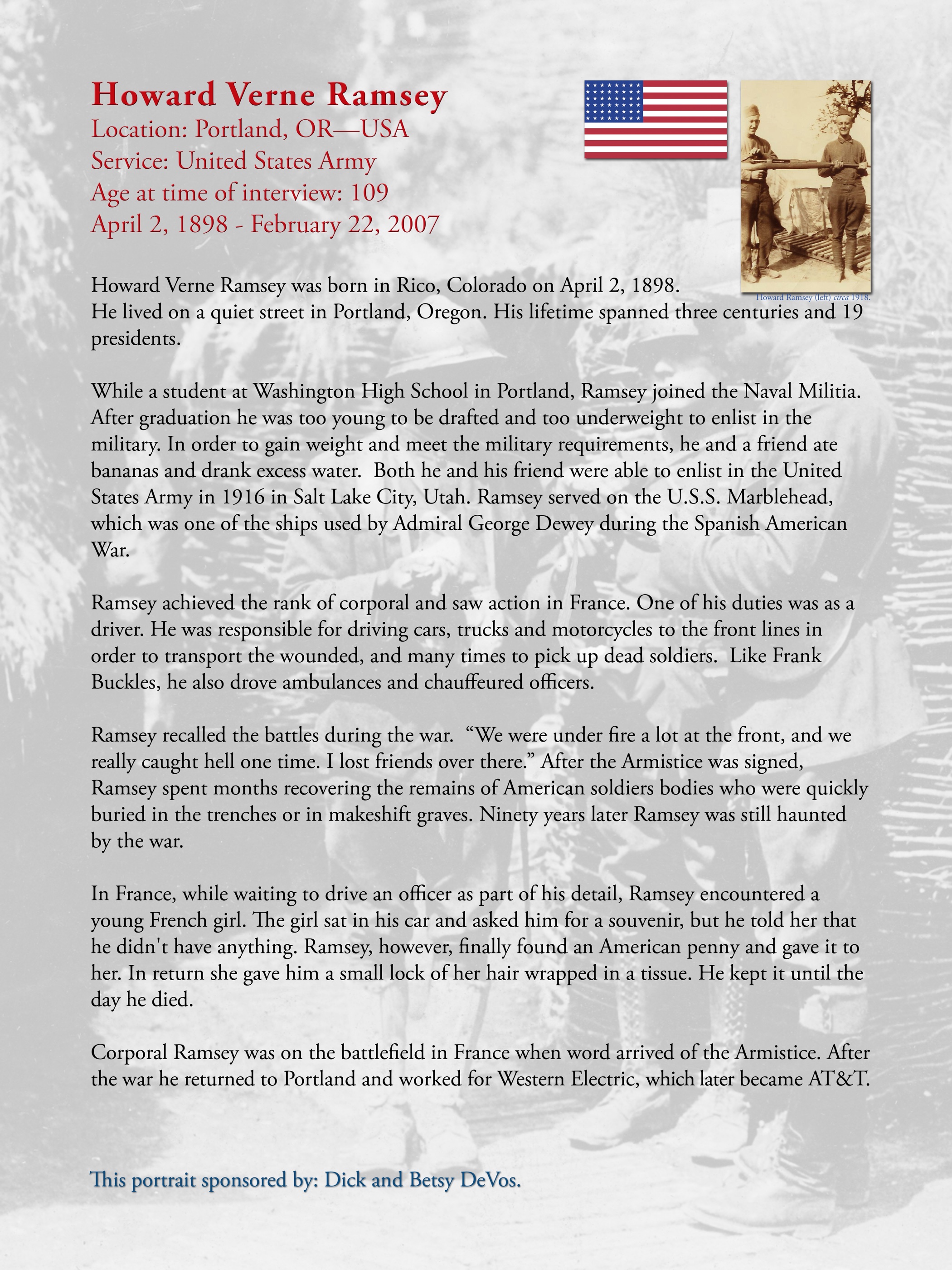
Original exhibition story panel for Howard Verne Ramsey
Original exhibition panel by David J. DeJonge · Select to view at full web resolution
Read the complete original text

Howard Verne Ramsey was born in Rico, Colorado on April 2, 1898 and lived on a quiet street in Portland, Oregon. His lifetime spanned three centuries and 19 presidents.

He first joined the Naval Militia at Washington high school and served on the U.S.S. Marblehead, which was one of the ships used by Admiral George Dewey during the Spanish American War. After his school Ramsey was to young to be drafted and to light to enlist so he and a friend at bananas and drank enough water to gain enough weight to be accepted. They enlisted in 1916 in Salt Lake City, Utah.

Ramsey achieved the rank of Corporal and saw action in France. One of his duties was as a driver. He was responsible for driving cars, trucks and motorcycles to the front lines to pick up the dead soldiers and transport the wounded. Like Frank Buckles he also drove ambulances and chauffeured officers.

“We were under fire a lot at the front, and we really caught hell one time. I lost friends over there.” After the Armistice was signed Ramsey spent months recovering the remains of American soldiers bodies who were quickly buried in the trenches or in make shift graves. 90 years after the war Ramsey was still haunted from the war.

While in France, Howard encountered a young French girl when he was waiting to drive an officer as part of his detail. The girl sat in his car and asked for a souvenir, when he told her that he didn't have anything, he found an American Penny and gave it to her. She in return gave him a small locket of hair wrapped in a tissue. He kept it until the day he died.

Corporal Ramsey was on the battlefield in France when word arrived of the Armistice. After the war he returned to Portland and worked for Western Electric, which later became AT&T.

Documented record

Sources.