British continuation · Britain 01

Henry William Allingham

🇬🇧United Kingdom

Royal Naval Air Service · Royal Air Force

Henry Allingham was the last surviving founding member of the Royal Air Force, the last surviving Royal Naval Air Service member, and the last survivor of the Battle of Jutland.

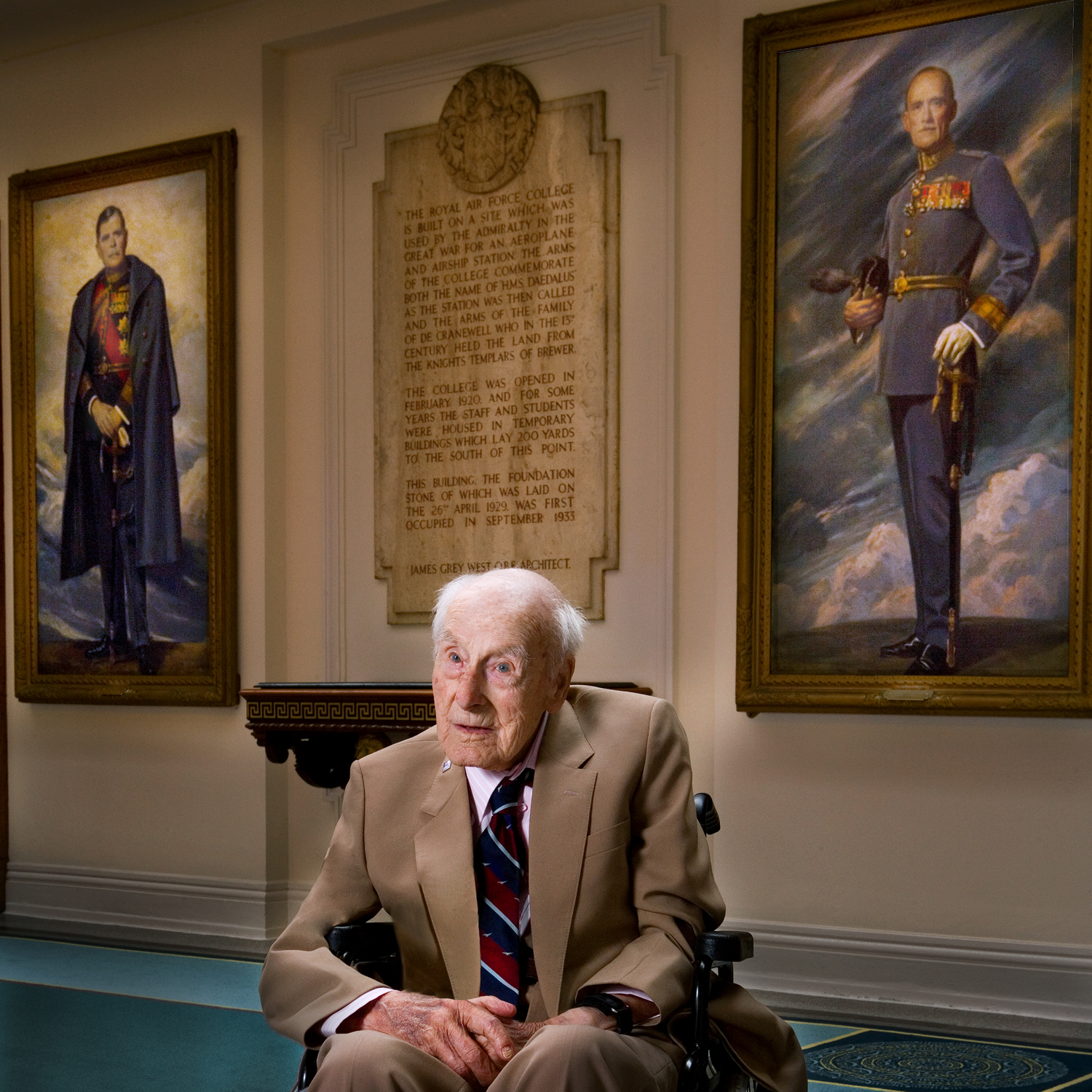
Portrait of Henry Allingham by David J. DeJonge
Photograph by David J. DeJonge · From the Last Witnesses portrait record
Collection
British continuation
Service nation
United Kingdom
Service
Royal Naval Air Service · Royal Air Force

The verified story

A life carried forward in the record.

Henry William Allingham was born June 6, 1896, in London. He joined the Royal Naval Air Service in 1915 as an air mechanic, entering military aviation when aircraft were still experimental machines used for reconnaissance as well as attack. In the account DeJonge preserved, Allingham remembered early flight methods that now seem almost handmade: pigeons carried aloft for communication and bombs handled individually in open aircraft.

In 1916 he served with HMT Kingfisher and witnessed the Battle of Jutland, the largest naval engagement of the war. He recalled shells and gunfire crossing the North Sea while the vessel worked in support of the British fleet. When the Royal Naval Air Service and Royal Flying Corps were combined on April 1, 1918, Allingham became a founding member of the new Royal Air Force. After discharge, he joined Ford and worked there until retirement.

DeJonge photographed Allingham in England around his 112th birthday at RAF Cranwell. The setting joined the service’s beginning to its modern form: an elderly mechanic from open-cockpit aviation honored beneath contemporary aircraft. Yet the portrait is quieter than the ceremony. Allingham’s face carries an eyewitness record of air power before doctrine, of a naval battle seen from the water, and of an institution born while war was still underway. His extraordinary age made him famous; the substance of the portrait is the history he alone could still describe.
The completed record

What followed.

Allingham died on July 18, 2009, at 113. At his death he was the world’s oldest living man, the last surviving founding member of the Royal Air Force, the last surviving member of the Royal Naval Air Service, and the last survivor of the Battle of Jutland. After DeJonge’s session, he joined Harry Patch and William Stone at the 90th-anniversary Cenotaph ceremony in November 2008 and received France’s Légion d’Honneur in 2009. He was not the last British First World War veteran overall.

The archive · c. 2009–2010

David’s original exhibition story.

This text is preserved from the original traveling-exhibition record. It retains the language, grammar, and understanding of that moment. Dates, survivor distinctions, and later developments are corrected in the verified record above.

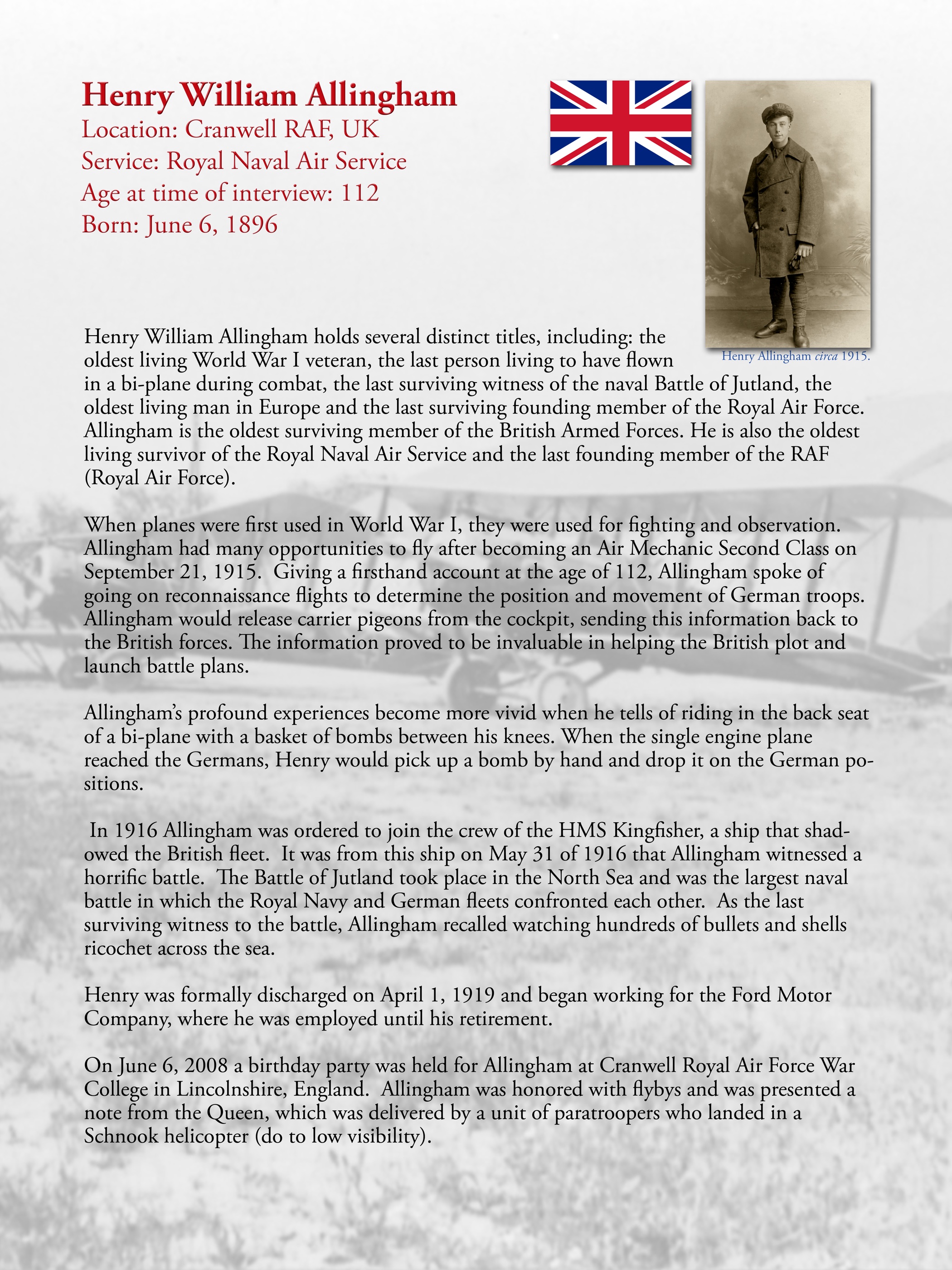
Original exhibition story panel for Henry William Allingham
Original exhibition panel by David J. DeJonge · Select to view at full web resolution
Read the complete original text

Henry Allingham Cranwell RAF, Lincolnshire- UK Royal Naval Air Service Age at time of interview: 112 June 6, 1896

Henry holds several distinct titles including: the oldest living WWI veteran, the last person living to have flown in a bi-plane during combat, a last survivor who witnessed the battle of Jutland, the oldest living man in Europe and the last surviving founding member of the Royal Air Force. Henry Allingham is the oldest surviving member of the British Armed Forces. He is also the oldest living survivor of the Royal Naval Air Service and the last founding member of the Royal Air Force.

On June 6, 2008 a birthday party for Henry was held at Cranwell Royal Air Force War College in Lincolnshire, England. Henry was honored by flybys and a delivery of a note from the Queen by paratroopers who landed in a Schnook helicopter.

When planes were first used in WWI they were used for fighting and observation. Allingham as an Air Mechanic Second Class on September 21, 1915 he had many opportunities to fly. Giving a first hand account at the age of 112 Henry spoke of releasing passenger pigeons from the cockpit of the plane while in flight to describe the positions of the German Troops and their movements of which the English based battle plans.

Allinghams profound experience is solidified when he tells of riding in the back seat of a bi-plane with a basket of bombs between his knees. When the single engine plane reached the Germans, Henry would pick a bomb up by hand and drop it on the German positions.

In 1916 Allingham was ordered to join the HMS Kingfisher. On May 31 of 1916 Allingham witnessed the Battle of Jutland the largest Naval Battle in which the Royal Navy and the German fleets confronted each other. The full scale fight occured in the North Sea. As the last surviving witness to the battle, Allingham recalled watching hundreds of bullets and shells ricochet across the sea. The Kingfisher shadowed the British fleet it was from this boat that Allingham witnessed the horrific battle.

Henry was formally discharge on April 1, 1919 and joined the Ford Motor Company where he worked until his retirement.

Documented record

Sources.