The verified story
A life carried forward in the record.
James Russell Coffey was born in Tiro, Ohio, on September 1, 1898. He was twenty and attending college when he entered the U.S. Army in October 1918. His service came at the war’s closing edge: Coffey remained in the United States, attained the rank of sergeant, and was honorably discharged on December 12, one month after the Armistice.
The brief military record was only one part of a long life. Coffey earned bachelor’s and master’s degrees from Ohio State University and a doctorate in education from New York University. He taught in schools and colleges, spent two decades on the faculty of Bowling Green State University, directed graduate study in health and physical education, officiated sports, and served his Rotary club for more than fifty years.
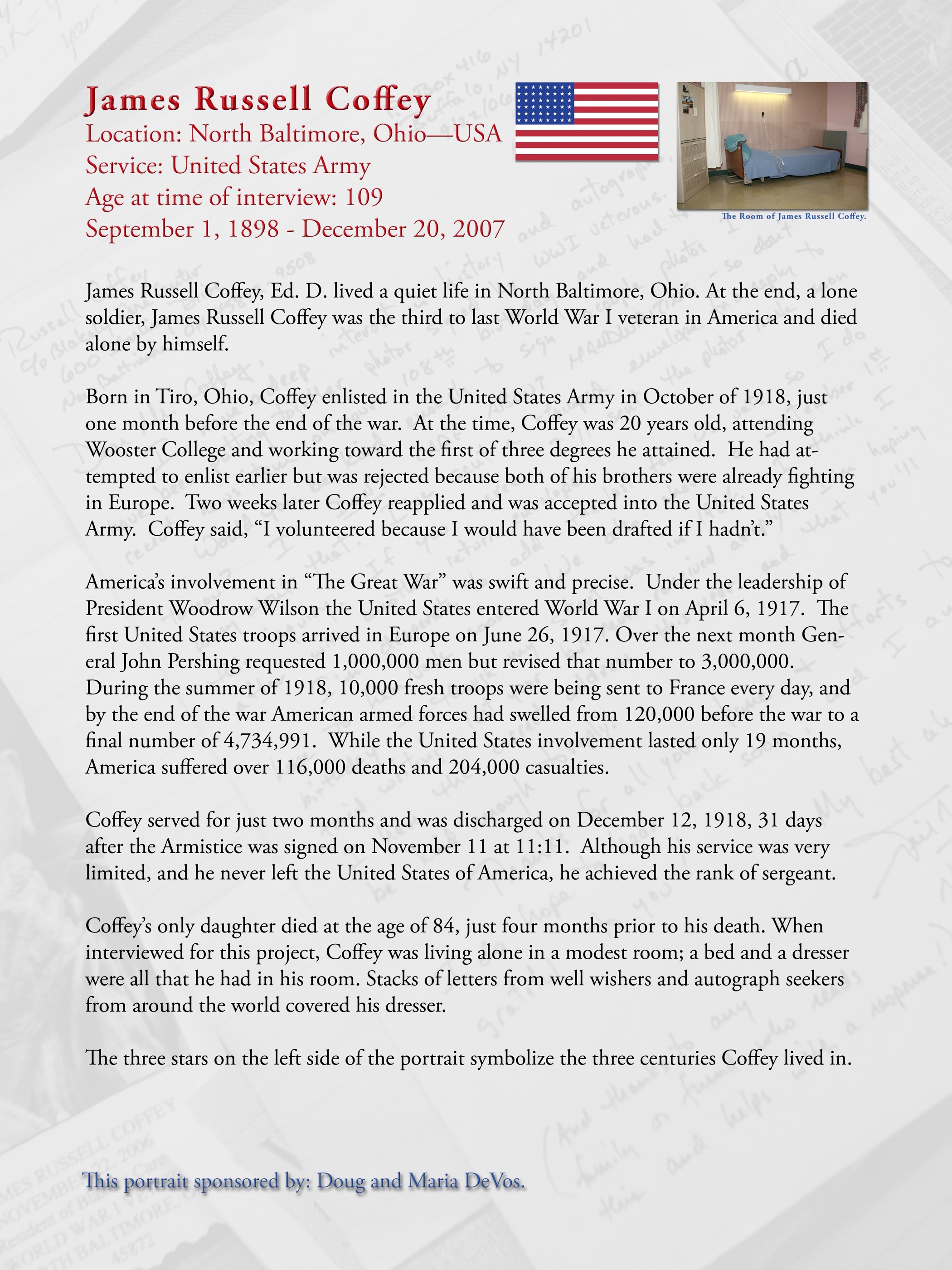
DeJonge encountered him at the opposite end of that full career. Coffey’s daughter had recently died. His room was modest—a bed, a dresser, and stacks of letters from well-wishers and autograph seekers around the world. During the short portrait session, a nurse asked him to open his eyes. He did, briefly, and then closed them again. DeJonge used three stars in the portrait to mark the three centuries through which Coffey had lived. The image does not pretend that he saw battle. Its power lies elsewhere: in the quiet face of a man whose small window of wartime service had made him one of the country’s final living links to 1918.